

Shopping decisions
Is Free Shipping Worth It? A Checkout Checklist
Quick Answer
Compare both complete checkout totals, then decide whether you need the extra item. Discounts and qualifying rules can change the result.
Pip's fictional checkout / before tax
Original order
- Items subtotal
- $35.00
- Shipping
- $5.00
- Checkout total
- $40.00
Order with extras
- Original items
- $35.00
- Extra items
- $12.00
- Shipping
- $0.00
- Checkout total
- $47.00
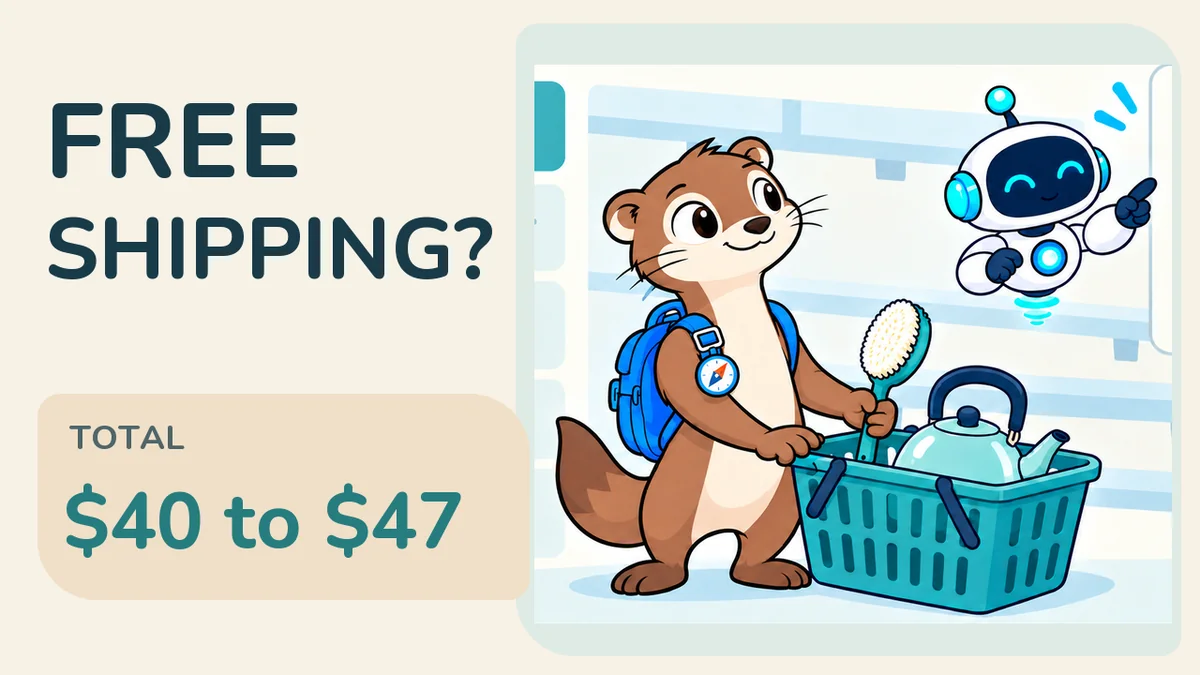
$7 more at checkout for an extra item priced at $12.
Try the calculatorBefore you add it

0 of 4 checks marked
Checks stay on this page. Marking a box does not change an order or subscription.
Try your own amounts. The calculator excludes tax, coupons and other fees.
Details & Limitations
Steps, conditions & supporting guidance
This checklist turns the free-shipping episode into a practical comparison. It uses fictional USD amounts and leaves tax out so the arithmetic is easy to follow. At a real checkout, include every applicable charge.
1. Save the original delivered total
Start with the items you intended to buy. Record the merchandise subtotal, shipping, tax, discounts, and any other fees before adding anything.
In Pip’s example, the kettle is $35 and delivery is $5. His starting comparison is $40 delivered, not just a $35 item.
2. Price the actual item you would add
The store’s free-shipping minimum is $45, so the remaining gap is $10. But Pip’s extra brush costs $12. His new merchandise total is $47, shipping becomes $0, and the delivered order is $47.
Calculate new delivered total − original delivered total. Here, $47 − $40 = $7 more. The brush’s listed price is still $12; $7 is the change between complete orders.
Enter the cost of the items you would actually add in the Free Shipping Calculator. It compares the two checkout totals, including cases where the new basket stays below or goes above the free-shipping threshold. The calculator does not include coupons; the separate example below states its own discount rule.
3. Recheck the qualifying rules
Before treating the new basket as eligible, check:
- Do all selected items count toward the minimum?
- Is the threshold tested before or after discounts?
- Does the benefit apply to this destination and delivery method?
- Are there item exclusions, surcharges, or membership conditions?
- What does the final checkout actually charge?
In a separate fictional after-discount test, $47 of items minus a $4 coupon becomes $43. If that falls below a $45 minimum, adding back $5 shipping produces a $48 bill. This is a reason to compare the final amount, not a claim about every retailer’s coupons.
4. Check usefulness separately from price
A third working brush and a necessary replacement brush can have very different value. Neither the shipping label nor the calculator knows which one you are buying.
5. Compare realistic alternatives
Consider waiting for a planned purchase, comparing another store’s delivered price, or using pickup if available. Include waiting time, travel, and the need for the original item. No alternative guarantees a saving.
The final check is simple: Do I prefer the complete new order, at its complete price, to the order I originally wanted?
For the evidence behind threshold offers and the full Pip-and-Nagi example, read Why Do We Spend More to Get Free Shipping?.
Follow another question

How Do Free Apps Make Money? The Business Behind Free
Why Do We Spend More to Get Free Shipping?

Why Is It So Hard to Cancel a Subscription?
Editorial notes
About this explanationAdapted from TDQ production scripts and research with AI-assisted drafting. Pip and Nagi's examples are fictional. Website approval: human-approved revision. Prepared . Editorial approach.
Sources & further reading
- Chen & Ngwe — Shipping Fees and Product Assortment in Online Retail (2018)
Background research on basket changes near a threshold. The checklist and fictional arithmetic are TDQ's editorial decision framework, not a measured saving.