

Money & Behavior · EP03
Why Do We Spend More to Get Free Shipping?
Free shipping can make a bigger order feel like a better deal. But does it actually cost less?
Quick Answer
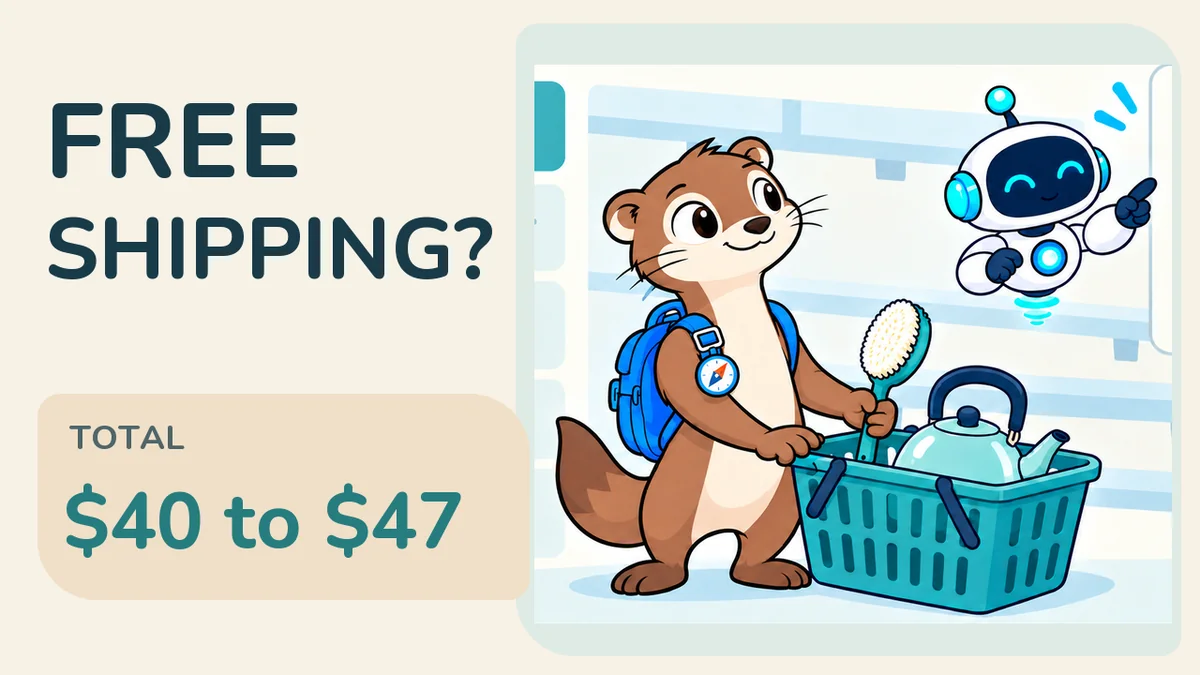
Removing a shipping charge can still increase the whole bill. In Pip’s fictional order, paying shipping costs $40; adding the $12 brush costs $47, with another item included.
Free Shipping Calculator
You pay $7.00 more at checkout.
Original order
- Items subtotal
- $35.00
- Shipping
- $5.00
- Checkout total
- $40.00
Order with extras
- Original items
- $35.00
- Extra items
- $12.00
- Shipping
- $0.00
- Checkout total
- $47.00
- Amount needed before adding items
- $10.00
- Difference in checkout totals
- $7.00
With extra items: free shipping reached.
Whether you need the extra item is your decision.
Assumptions & privacy
USD, before tax. The threshold uses the merchandise subtotal, with no discounts, exclusions or other fees. A basket below the minimum still pays shipping. Inputs are processed on this page, without being sent or saved.
A delivery offer can shift attention away from the whole bill. Compare the actual extra purchase with the delivery fee before deciding.

The brush is the real question

The calculator compares complete orders. Whether the extra item is useful is a separate decision.
A discount can bring shipping back
This separate fictional store checks its $45 minimum after discounts:
$47 items + $0 delivery
$43 items + $5 delivery
Check the store’s qualifying subtotal; coupon and delivery rules vary.
Key takeaways

- Compare complete delivered totals.
- Enter the actual extra item price, not just the gap.
- Check discounts and whether you need the extra item.

Evidence & Limitations
Read the research and its limits
Partitioned pricing
Research on partitioned pricing, which separates a base price from another charge, finds that the presentation can affect remembered total costs and demand. That supports paying attention to how a price is presented; it does not prove that everyone dislikes shipping more than product prices. University research summary
What purchase records can show
A 2018 working paper studied an online clothing retailer in the Philippines using 2012–2016 transactions and a demand model. Orders clustered around shipping thresholds in patterns consistent with people adjusting baskets. This was not randomized assignment, and a transaction record cannot reveal whether every added item was wanted. Chen and Ngwe
Observed purchasing patterns and an explanation of one person’s motives are not interchangeable evidence. Both can inform the question without establishing the same thing.
Delivery still requires work
When a customer-facing shipping charge becomes zero, picking, packing and transport do not disappear. The customer fee is not necessarily the retailer’s actual fulfillment cost. A retailer might expect the money remaining after merchandise costs to help cover delivery, or accept a lower margin as a promotion. This is a possible business explanation, not a claim that an exact delivery amount is hidden in every item’s price.
More orders or larger baskets do not guarantee more profit. One study of an online retailer found that shipping promotions generated additional sales but were unprofitable in that setting. Its result should not be generalized to every retailer. Lewis, Singh and Fay
Limits of the examples and tool
The opening comparison is fictional and before tax. Every item qualifies; no discount, membership benefit or other charge applies. The calculator uses the actual extra purchase and retains shipping if the expanded basket is still below the minimum. It does not assign value to a product.
Waiting until you need another item, comparing another store’s delivered total or considering pickup may change the decision. Include time, travel cost, urgency and storage. Buying an unwanted item with a plan to return it is not a guaranteed shortcut: return terms and effort matter too.
Example assumptions & distinctions
In the main fictional order, the $35 kettle and $12 brush reach the $45 threshold. The $10 gap is not the $12 extra purchase. The $7 difference between delivered totals is neither the brush’s sticker price nor automatically a loss; the larger order includes another product.
The separate fee catching Pip’s attention, the minimum becoming a target and his search for an extra item interpret the fictional story, not every shopper. Coupon eligibility, excluded items and whether thresholds apply before or after discounts vary. Parcel shipping, local delivery and pickup may have different rules.
The store’s minimum explains how to qualify. It does not provide a shopping list. Use the checkout checklist before adding an item you would otherwise leave behind.
Common Misconceptions
Free shipping means the smallest bill.
The added item can cost more than the shipping it removes.
The gap to the threshold is my extra spending.
Use the price of the item you actually add, which may overshoot that gap.
Common questions
Is it worth buying more to get free shipping?
Compare the final totals first. If an extra item costs more than the shipping fee it removes, you spend more at checkout. It can still be a useful purchase if you need the item; the checkout difference and the item's personal value are separate questions.
Is the amount needed for free shipping the same as my extra spending?
Not necessarily. You may need $10 to reach a threshold, but the item you choose might cost $12. Use the actual added-item price and the final delivery charge, not just the gap shown by a progress bar.
Can a coupon make my final order more expensive?
It can under a rule that checks the free-shipping minimum after discounts. If a coupon drops the qualifying subtotal below that minimum and shipping is added back, the new total can be higher. This depends on the retailer's actual terms.
Watch the corresponding episode
Why Do We Spend More to Get Free Shipping?
The player connects to YouTube only when you choose to load it. YouTube then receives technical request data and this site's origin, and its data processing applies. Privacy information.
Watch directly on YouTube →Follow another question

How Do Free Apps Make Money? The Business Behind Free
Is Free Shipping Worth It? A Checkout Checklist
Why Is It So Hard to Cancel a Subscription?
Editorial notes
Source review date: . Retained evidence and access limitations are identified in the source notes.
About this explanationAdapted from TDQ production scripts and research with AI-assisted drafting. Pip and Nagi's examples are fictional. Website approval: human-approved revision. Prepared . Editorial approach.
Sources & further reading
- Morwitz, Greenleaf & Johnson (1998) — Divide and Prosper
University abstract on partitioned pricing. It does not establish one universal reaction to delivery fees.
- Chen & Ngwe (2018) — Shipping Fees and Product Assortment in Online Retail
HBS Working Paper 19-034. Observational Philippine retailer data from 2012–2016 and a demand model, not a randomized threshold experiment.
- Lewis, Singh & Fay (2006) — Nonlinear Shipping and Handling Fees
Publisher abstract reports additional sales but unprofitable promotions in the retailer studied; not a universal profit result.