

Digital advertising · EP07
Why Do Ads Follow Us Around the Internet?
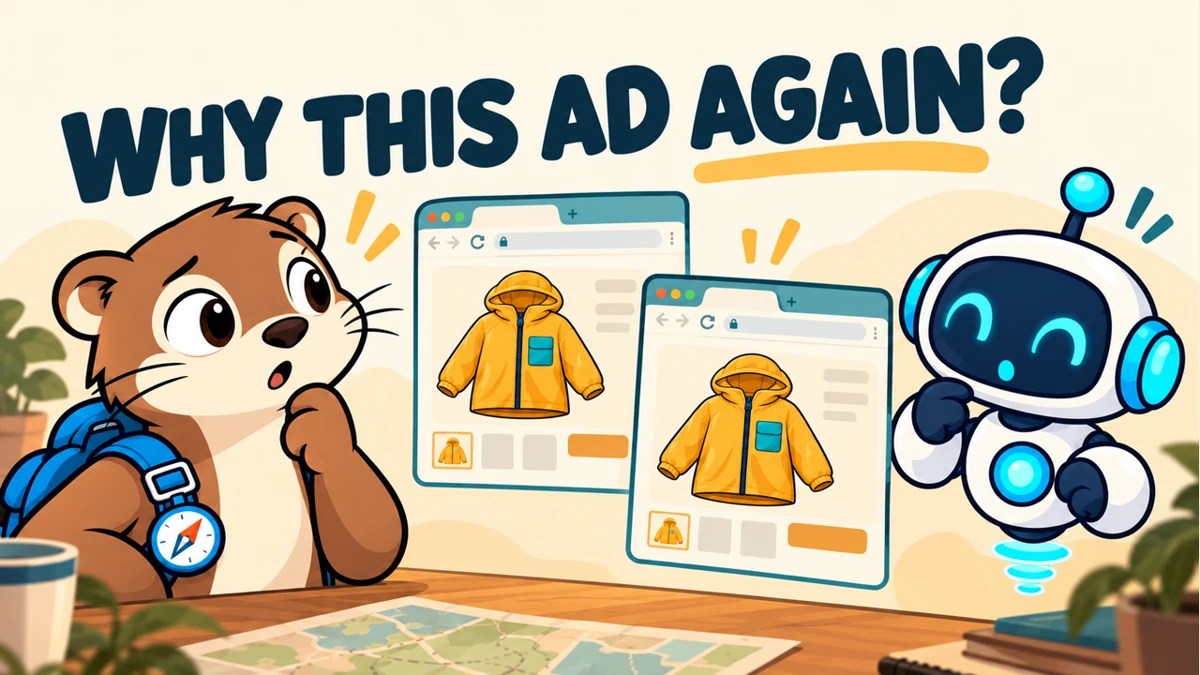
The same rain jacket, on another site. What can that actually tell you?
Quick Answer
A previous visit can help an advertiser reach you again under some conditions. A matching ad alone does not establish why it appeared: context and other selection factors can produce similar results.
The same jacket. More than one possible reason.

A familiar ad alone does not tell you why it appeared.
A familiar ad is a clue, not a complete tracking log. Understanding the limits of that clue helps distinguish what an advertising route could do from what one screen proves.
Same jacket. What can Pip establish?
An advertiser can try to reach previous visitors. In one possible arrangement, a product-view event is associated with an allowed identifier; product information helps select a later ad. Reaching the visitor and selecting the product are separate decisions.
The same-looking ad could also reflect page context or other selection factors. The match is visible. Its cause needs more evidence.
Choose the control for your goal
| Action | What it addresses |
|---|---|
| Remove a browser cookie | That saved browser clue |
| Change ad personalization | The provider’s stated personalization settings |
| Request record deletion | The service records covered by that request |
Read the provider’s current scope. One control does not establish that all ads or separate records are gone.
Key takeaways

- A previous visit is one possible explanation.
- An identifier and the record it helps locate are different.
- An ad’s appearance alone cannot establish its tracking history.

Evidence & Limitations
Read the technical sources and their limits
A provider’s explanation of one route
Google’s dynamic remarketing documentation describes using past visits and product information for relevant ads. Its business claims should not be treated as an independent measurement of effectiveness, or as evidence for why Pip saw a particular ad. Remarketing documentation
Site context and browser policies
MDN explains first- and third-party cookie context. This concerns the relation to the current site, rather than simply who owns a company. Browser restrictions, consent and settings can change what is possible. Cookie context
Personalization and advertising are separate
Google describes both personalized and non-personalized ad selection and different settings for its services and partner contexts. That documents one provider’s controls. It does not establish that switching one setting affects every ad service or erases separate records. Provider scope
The jacket scene illustrates a possible route rather than a real tracking log. The explanation does not establish the cause of an individual ad, repeat a provider’s effectiveness claim as a measured result, or diagnose microphone use.
Example assumptions & distinctions
Pip’s jacket scene is fictional, not a recording of an advertising request. Available routes depend on browser and device rules, permissions, account state and provider settings; there is no single universal mechanism established here.
A short identifier need not hold a complete browsing history or a real name. Omitting a real name does not guarantee anonymity. Removing a browser clue is not proof of server-record deletion; disabling one provider’s personalization does not govern every company or remove every ad. No privacy-product purchase or promise of total invisibility follows from this example.
For a useful remembered state, explore how a website remembers your cart. Then distinguish that storage design from the wider advertising question.
Common Misconceptions
A repeated ad proves my microphone was used.
The ad alone cannot establish that. Other possible explanations need to be considered and checked.
Turning off personalization means no ads.
A provider can still show ads using permitted contextual information; controls have defined scopes.
Watch the corresponding episode
Why Do Ads Follow Us Around the Internet?
The player connects to YouTube only when you choose to load it. YouTube then receives technical request data and this site's origin, and its data processing applies. Privacy information.
Watch directly on YouTube →Follow another question
How Do Free Apps Make Money? The Business Behind Free
How Do Websites Remember Your Cart?
Why Is It So Hard to Cancel a Subscription?
Editorial notes
Source review date: . Retained evidence and access limitations are identified in the source notes.
About this explanationAdapted from TDQ production scripts and research with AI-assisted drafting. Pip and Nagi's examples are fictional. Website approval: human-approved revision. Prepared . Editorial approach.
Sources & further reading
- Google Ads — About dynamic remarketing
A provider’s technical description of past-visitor product ads; not independent evidence for a specific ad or a promised sales effect.
- MDN — Third-party cookies
First- and third-party context and storage behavior. Browser policies and settings matter.
- Google My Ad Center — How personalized ads work
Google’s stated personalization controls and non-personalized contexts; not every advertising provider’s policy.