

Time and decisions · EP04
Why Do We Finish Movies We Don't Like?
An hour already watched stays spent. What would you choose for the next one?
Quick Answer
The hour already watched cannot be recovered by either choice. Compare what the remaining hour offers with what you could do instead; finishing can still be worthwhile.
The first hour cannot choose the next.
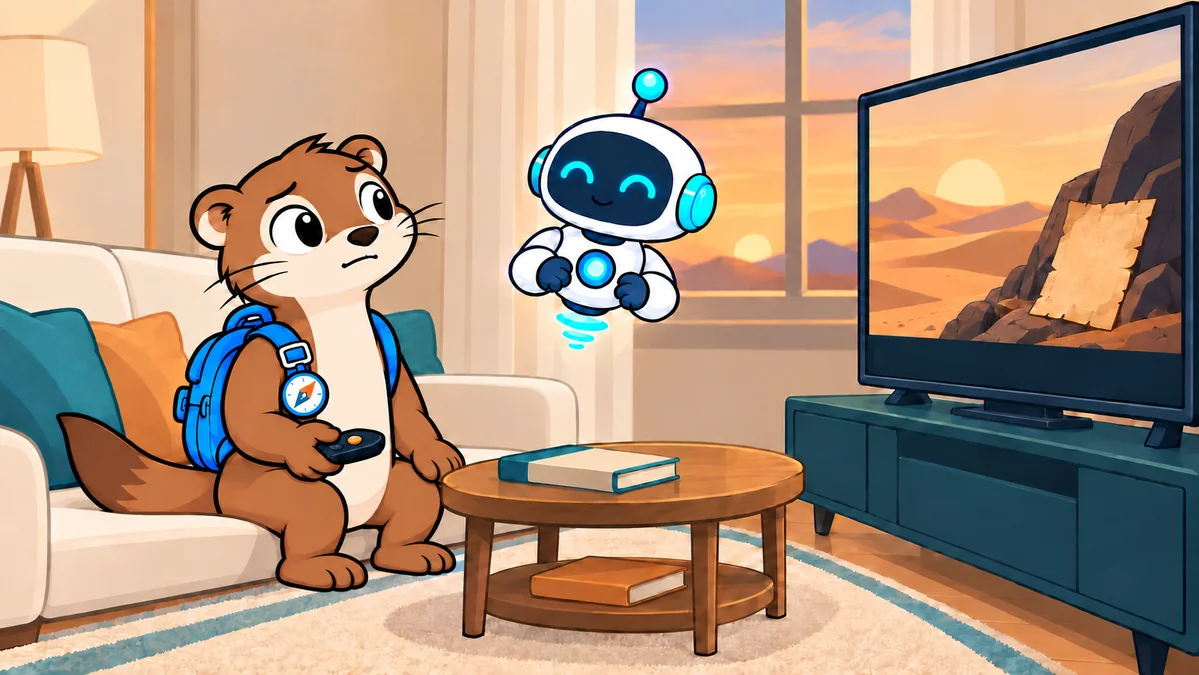
60 minutes spent. 60 minutes still yours.
A disappointing movie makes a familiar decision visible: whether to justify time already spent or compare the options still available.
Which next hour would you choose?
Pip is halfway through a fictional two-hour movie. The spent hour is a sunk cost: these choices cannot recover it.
| Available now | What comes next |
|---|---|
| Keep watching | The remaining hour and the ending |
| Leave it paused | Time for another activity |
What still matters
Wanting the ending, enjoying company or avoiding the effort of switching can still matter. What the first hour taught Pip is useful information; trying to recover it by staying is a different reason.
Key takeaways

- Both choices have the same past.
- Compare the benefits and costs still ahead.
- Continuing and stopping can both be reasonable.

Evidence & Limitations
Read the research and its limits
Tickets, tasks and hypothetical choices
In the classic theater season-ticket study, people assigned the full price used more tickets during the first half of the season than people assigned discounts. The difference did not remain significant in the second half. These were purchases and ticket-use observations, not tests of whether viewers endured bad films. Arkes and Blumer
Navarro and Fantino’s publisher abstract reports sunk-time effects in questionnaire and behavioral studies, including an interaction involving personal responsibility. That supports a limited claim about the tasks they studied, rather than a rule that every extra minute makes everyone more determined to finish. Publisher abstract
Registered replication work also distinguished hypothetical time investments from money investments. Those decisions cannot establish what motivates a particular person on a couch. Petrov and colleagues
Waiting for a clip is not watching a movie
Another experiment examined waiting for short videos. Attention to the delay mattered for sensitivity to sunk costs. That is useful evidence about a defined task. It is not a direct experiment on losing interest halfway through a feature film. Kazinka and colleagues
The limits of this movie-night example
These ticket, task, hypothetical-choice and waiting studies do not identify the motive of a particular viewer. “Knowing what I know now, would I choose the remaining hour?” is a reflection prompt, not a proven treatment. Staying and stopping can both be reasonable. This article does not establish that sunk time is the only explanation for finishing.
Example assumptions & distinctions
This home-viewing example allows pausing and returning later, with no stated deadline. A live performance can present different options. If a refund is actually available, it belongs in the future comparison rather than in unrecoverable costs.
Pip chooses reading while leaving the movie paused; he does not regain the first hour.
Another activity can also make continuing easy. Explore why we keep scrolling and compare an investment already made with the hope of the next discovery.
Common Misconceptions
Finishing returns the time I spent.
That hour remains in the past under either choice.
Sunk costs mean I should always quit.
Curiosity, company and other future benefits can still make continuing worthwhile.
Watch the corresponding episode
Why Do We Finish Movies We Don't Like?
The player connects to YouTube only when you choose to load it. YouTube then receives technical request data and this site's origin, and its data processing applies. Privacy information.
Watch directly on YouTube →Follow another question
Why Do We Spend More to Get Free Shipping?

Why Do We Keep Scrolling Even When We're Bored?
How Do Free Apps Make Money? The Business Behind Free
Editorial notes
Source review date: . Retained evidence and access limitations are identified in the source notes.
About this explanationAdapted from TDQ production scripts and research with AI-assisted drafting. Pip and Nagi's examples are fictional. Website approval: human-approved revision. Prepared . Editorial approach.
Sources & further reading
- Arkes & Blumer (1985) — The Psychology of Sunk Cost
University-hosted copy of the published paper; Experiment 2, printed pages 126–128, checked October 27, 2026. Theater-ticket use is not time spent watching a disappointing movie. No reanalysis of the data was performed.
- Navarro & Fantino (2009) — The Sunk-Time Effect, An Exploration
Publisher abstract checked October 27, 2026: questionnaire and behavioral studies, including a personal-responsibility interaction. Individual task procedures and statistics were not verified from the full text.
- Petrov et al. (2023) — Sunk Cost Effects for Time Versus Money
Registered replication and extensions using hypothetical choices. The publisher-hosted abstract and procedure were checked October 27, 2026; outcomes differ across tasks. No statistical reanalysis was performed.
- Kazinka, MacDonald & Redish (2021) — Sensitivity to Sunk Costs Depends on Attention to the Delay
Waiting for short videos, with attention to waiting manipulated. Waiting is not the same activity as watching a disappointing feature film.