

Attention and interfaces · EP05
Why Do We Keep Scrolling Even When We're Bored?
Not enjoying this post? Pip is still hoping for the next good one.
Quick Answer
Another swipe may be a search for a better post, rather than enjoyment of the current one. Habit, expectations and a feed without a clear ending can contribute; no single cause explains every session.
Another swipe. Another enjoyable post?
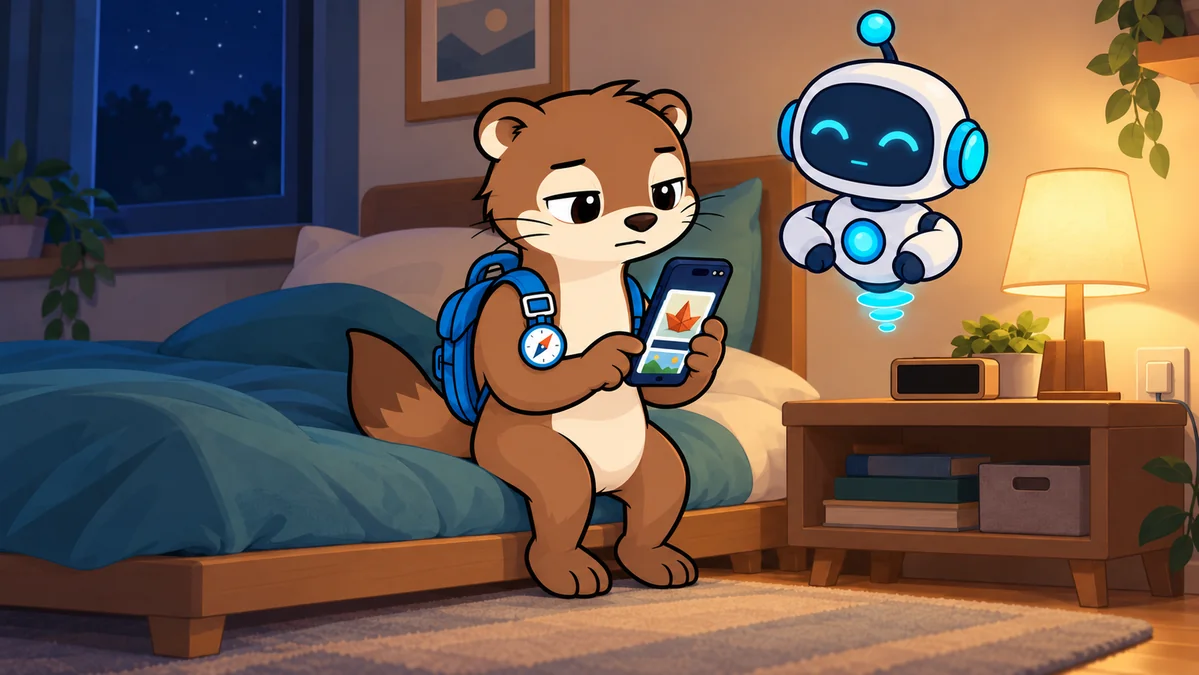
11:40 p.m. becomes 12:15 a.m.
Continued use does not always mean current enjoyment. Separating opening, continuing and stopping makes the next choice easier to examine.
Looking for the next good post
A familiar moment can cue opening an app. A promising next post can encourage another swipe. A feed without a last page may offer fewer natural stopping points.
Give “one more” an ending
Pip and Nagi imagine three posts, then a choice:
“I want to see more.”
“That’s enough for now.”
This is a fictional design idea, not a tested way to reduce scrolling. Choosing to continue can be deliberate too.
Key takeaways

- Opening, continuing and stopping are different moments.
- Enjoying this post and hoping for another are different.
- A visible choice invites reflection; it guarantees no outcome.

Evidence & Limitations
Read the research and its limits
Habits and accounts of continuing
Research on brief repetitive smartphone checking described habits that could lead into other activities on a device. Those older phones and services do not establish how every modern recommendation system works. A habit is also not, by itself, a diagnosis of addiction. Oulasvirta and colleagues
Interview accounts of searching for interesting material help explain why current enjoyment and continued use can diverge. They do not isolate a single cause of all scrolling. The content, the reason for opening, the interface and the person’s circumstances can all matter. Baughan and colleagues
Switching and boredom
In experimental work, switching between videos or within a video could increase boredom compared with staying with the same material. Some later conditions and more varied samples produced mixed results. These are short tasks, not evidence that a person has permanently damaged their attention. Tam and Inzlicht
Having something else to switch to does not guarantee a less boring experience. It does not follow that everyone should finish every uninteresting video.
Starting a session is not ending one
The one sec paper separates a six-week field study of target-app use from a controlled online video experiment. In that experiment, a pre-video skip option and a delay each reduced video consumption relative to control, while a deliberation message alone did not. One coauthor created one sec. These results concern choices before consumption; they do not establish that a three-post boundary stops an ongoing feed or that three is the right number. Grüning and colleagues
More interruptions are not automatically better
Research requiring reactions to posts found improved recognition alongside frustration and longer interaction with the test interface. That is not evidence that people browse longer in everyday life. Remembering more posts is a different result from browsing less. Ruiz and colleagues
These studies examine different tasks and outcomes. Recognition, task interaction time, frustration and viewing starts cannot be substituted for one another, or used to diagnose a particular person’s evening.
Example assumptions & distinctions
The 11:40 p.m.–12:15 a.m. evening is fictional; 35 minutes is not a study average or a diagnosis. Three posts is an illustrative boundary, not an established optimum, and this episode did not test its effectiveness.
Habit, expectations, content, interface and circumstances can matter together. Familiar use alone does not establish addiction. Finding a recipe or reading a message can provide a stopping condition, but such prompts are not proven interventions. Switching to something else does not guarantee less boredom; useful discoveries and deliberate continued viewing remain possible.
Compare this with the next hour of a disappointing movie: past investment and an expected next discovery are different reasons to keep going.
Common Misconceptions
Every swipe means I liked the last post.
Pip may be looking for the next interesting post instead.
More interruptions always mean less use.
Recognition, frustration and time spent are different outcomes; a design can improve one and worsen another.
Watch the corresponding episode
Why Do We Keep Scrolling Even When We're Bored?
The player connects to YouTube only when you choose to load it. YouTube then receives technical request data and this site's origin, and its data processing applies. Privacy information.
Watch directly on YouTube →Follow another question
Why Is It So Hard to Cancel a Subscription?
Why Do We Finish Movies We Don't Like?
How Do Free Apps Make Money? The Business Behind Free
Editorial notes
Source review date: . Retained evidence and access limitations are identified in the source notes.
About this explanationAdapted from TDQ production scripts and research with AI-assisted drafting. Pip and Nagi's examples are fictional. Website approval: human-approved revision. Prepared . Editorial approach.
Sources & further reading
- Oulasvirta et al. (2012) — Habits Make Smartphone Use More Pervasive
University bibliographic record and abstract for research on brief repetitive checking. Older devices and services limit direct extrapolation to current feeds.
- Baughan et al. (2022) — How Design Influences Dissociation on Social Media
Author-hosted CHI paper. Small Twitter-based field study and interviews; self-reported inattention is not a clinical diagnosis.
- Tam & Inzlicht (2024) — Fast-Forward to Boredom
Experimental video and reading tasks; results varied across samples and conditions. Not a test of permanent attention damage.
- Grüning, Riedel & Lorenz-Spreen (2023) — Directing Smartphone Use Through One Sec
Publisher full text checked October 27, 2026. Distinguishes a six-week app-use field study from a controlled online video experiment. One coauthor created one sec; starting an activity is different from stopping an ongoing scroll.
- Ruiz, Molina León & Heuer (2024) — Design Frictions on Social Media
Author-posted conference paper. Required reactions, recognition, frustration and task interaction time must be distinguished; this is not a measurement of long-term everyday browsing time.